

Chloride ions are highly mobile, which can cause problems for reinforced concrete. The chloride ions can penetrate into concrete over time and when their concentration around the steel reaches a critical mass, the passive protection layer formed by the concrete can be broken down leading to rusting of the steel and spalling of the concrete.
BS 8500 defines chloride exposure conditions as either XD for deicing salts applied to roads or XS in a marine environment. Both these classes are divided into 3 cases, with the most onerous being XD3 and XS3 (where the concrete is cyclically wet and dry).
The XD3 and XS3 areas are clearly defined e.g. XD3 is for structures within 10m horizontally of a carriageway or for bridge soffits within 5m vertically. However, it appears that Buzz Lightyear was on the drafting panel when XD1 zone was defined. XD1 is for structures greater than 10m horizontally and 5m vertically from a carriageway; i.e. to infinity and beyond, as no limit is specified.
Generally, this doesn’t have too big an impact on specifications as the limiting values (strength, water cement ratio, minimum cement content and cover to reinforcement) are not too onerous for XD1. However, sometimes specifications don’t permit certain materials to be used in a chloride environment, e.g. weathering steel, so if we are building a bridge near a motorway we need to have an idea what the likely spray zone is to know if these material restrictions apply.
For a recent project I’ve been working on, I came up with the following envelope using probabilistic modelling on the relationship empirically derived in Germany and used in fib bulletin 34 for the maximum content of chloride in a profile against distance from carriageway:

There is less research around to help evaluate the penetration of chlorides into the soil. However, considering the following facts:
- Salt is usually applied in freezing conditions therefore the chloride contaminated water will tend to run-off the hard ground.
- Chloride ions are mobile and will tend to flow away with groundwater
- Research shows increased chloride in aquifers near roads with salt spreading because the chlorides have been transported away (supporting the first two points above)
- High concentrations of chloride are not normally found at depths >1m
On this basis I limited the buried chloride zone to 2m giving the following overall envelope.
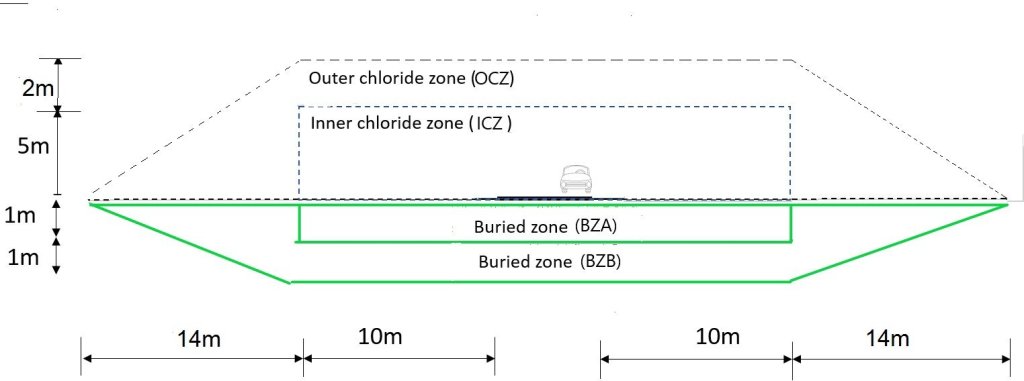
Logic tells you that a concrete element close to a motorway which will have a lot of traffic and relatively frequent salt addition in cold weather will be at far greater risk than one alongside a quiet road that may only get an occasional gritting and far less spray
It seems reasonable to me that you could differentiate your specification between busy (e.g. ‘M’ or ‘A’ roads) and quiet (e.g. ‘B’ or ‘unclassified’ roads). So my suggestion would be:
- Any element subject to direct application of chloride (quiet or busy road) design as XD3
- Any element in the ICZ on a busy road design as XD3 and XD1 in the OCZ.
- Any element in BZA on a busy road design as XD3 and XD2 in BZB
- On quiet roads use XD1 for all zones (except where subject to direct application- see above). Note to comply with the current versions of BS 8500 concrete in the ICZ should be classified as XD3 exposure (on both quiet and busy roads).
What do you think?
 It's grey and goes hard