Well yesterday’s post certainly stimulated some debate on LinkedIn and I was feeling a little like the boy in Hans Christian Andersen’s Fable about the emperor’s clothes. I was labelled as ignorant, wrong-headed and uninformed but then somebody sent me a link to a presentation given by Karen Scrivener and it was reassuring to know I was not alone in my thoughts. For those of you who don’t know Karen, her Wikipedia page describes her as follows:
Karen Louise Scrivener is a material chemist known for her pioneering works in cementitious materials. She is the head of Laboratory of Construction Materials at Ecole Polytechnique Fédérale de Lausanne and served as the Editor-in Chief of the Cement and Concrete Research journal for 15 years.
Wikipedia (16/12/21)
I doubt very much whether the same adjectives will be applied to Karen but the message she gives is very similar to mine.
I’ve been thinking about sustainability and specifying concrete a lot recently (yes I know I need to get out more!), particularly low carbon concrete and my increasingly strengthening opinion is that we’ve got it badly wrong. I’ve been reviewing the draft Low Carbon Concrete Routemap, prepared by Green Construction Board’s Low Carbon Concrete Group (LCCG) and while it contains many good points and highlights my major concern, which I will come to shortly, it’s proposed solution will make matters worse (in my humble opinion) by increasing global CO2 emissions.
I fear that many low carbon concretes, geopolymers and alkali-activated cementitious materials are modern day snake oil, marketed to be the ultimate in environmentally friendly products but in fact are an expensive way to make matters worse.
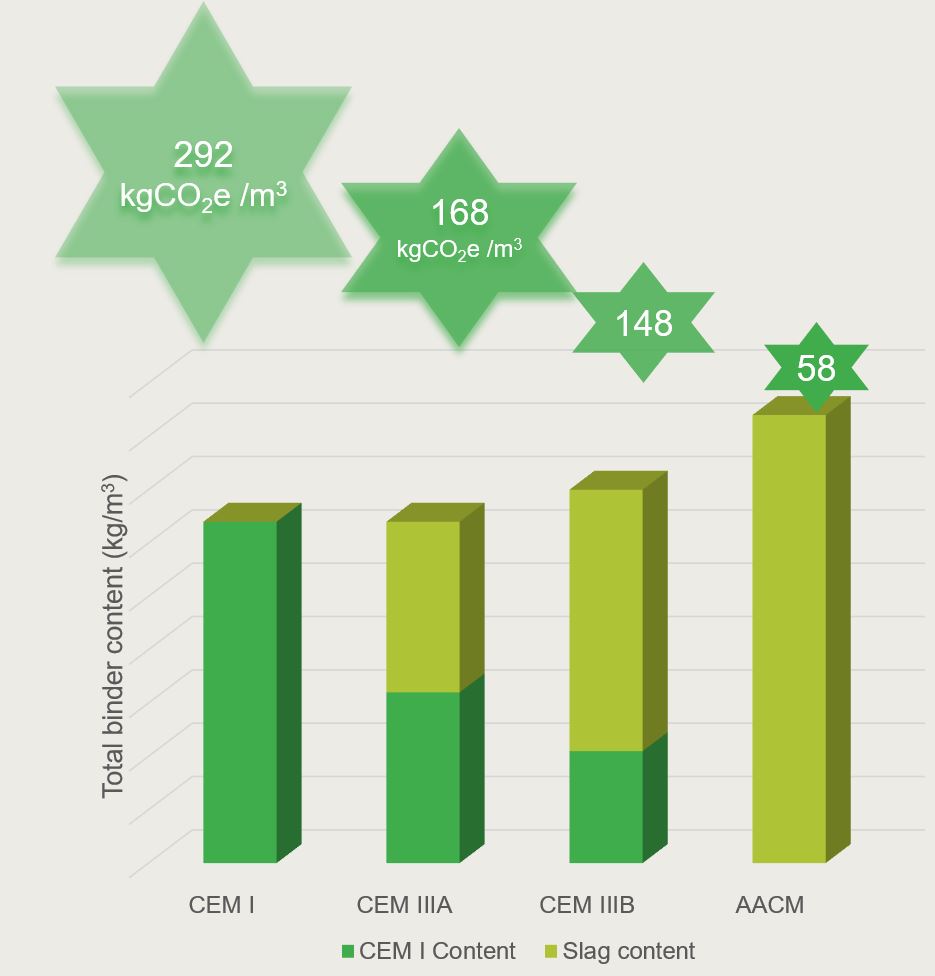
We are used to specifying concrete with supplementary cementitious materials (SCM) like ground granulated blastfurnace slag (a by-product from steel production) or fly ash (from burning coal to generate electricity). As these materials are effectively waste products generated from other processes, they have very low embedded carbon contents and therefore when blended with CEM I, to produce CEM III/A (typically 40-50% slag), CEM III/B (typically 70% slag), CEM II/B-V (typically 30% fly ash) or an alkali-activated cementitious material (up to 100% slag), they significantly reduce the carbon content of concrete as illustrated below for a C32/40.
When concrete is made using slag in a CEM III/A cement, it is generally produced with the same cement content as a concrete using only CEM I. If the slag content is increased to 70%, then to achieve the same 28 day strength the concrete needs a slightly higher total cement content (approximately a 10-15%) to compensate for the slower strength gain from slag cements (unless it is possible to specify a 56 or 90 day compliance age). Alkali activated cementitious materials using over 90% slag often need a significant increase in binder content to maintain an equivalent strength (25-35%). However, due to the low embodied carbon attributed to the slag compared to CEM I, then significant reductions in carbon are achieved despite the increase in binder contents.
So all is well and good. We could save 110 kgCO2e/m3 by switching from CEM III/A to AACM and we will be taking our DJs and posh frocks to the dry cleaners in preparation for the sustainability awards we’re bound to win. But wait, is that a butterfly I hear flapping its wings in the Amazon, is there about to be a tornado in Texas? Chaos theory tells us everything is linked and a small change in one part of the system can lead to significant changes elsewhere. Similarly, climate change is not a UK issue, it’s a global issue and we must think globally.
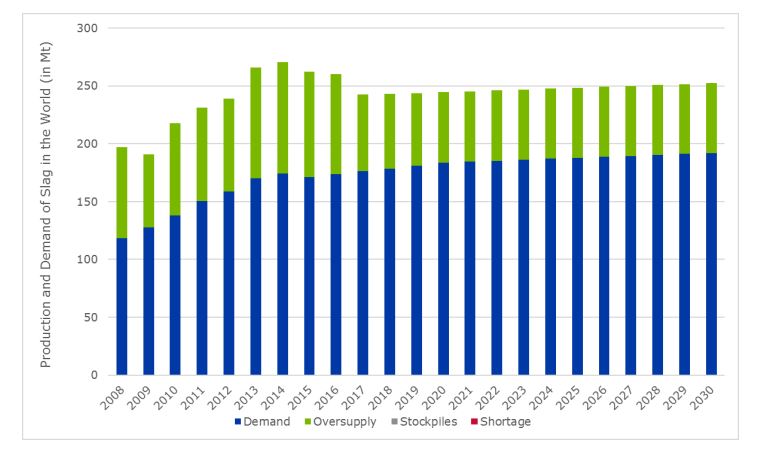
Annual global cement production is around 4.1 billion tonnes, which according to Global Cement will make approximately 10.1 billion m3 of concrete. To switch all CEM I to the environmentally friendly CEM III/A, we would need around 2.0 billion tonnes of slag. To convert all to AACM would require 5.4 billion tonnes of slag. The Department for Business, Energy and Industrial Strategy (BEIS) commissioned a report to look into the availability of fly ash and slag for cement manufacturing. The BEIS Technical Report 19 concludes that there is a global surplus of slag (see figure below). However, there are a number of assumptions in this data, the most significant being a factor of 4 is applied to account for the fact slag application is relatively high in the UK compared to the rest of the world. There also does not appear to be a separation of slag used for cementitious purposes and slag used as aggregate.
The BEIS report identifies that there are larger volumes of fly ash available (circa 600mT with approximately 200mT used). However, most of this fly ash is in China, India and the USA, away from the coast and consequently not readily available for shipping. Even if all the fly ash and slag in the world was available for use in concrete (which it clearly is not) it’s less than 20% of the cement production and in reality far lower than that.
Both materials are facing a long-term decline in production. While COP26 had a last minute softening on the aspiration to phase-out coal-powered electricity generation and weakened it to phase-down, the trajectory is clear and in most major construction markets the local availability of fly ash will decline. The switching of iron manufacturing from blast furnaces to lower carbon, slag-free electric-arc furnaces will see a decline in slag production.
The actual availability of slag and fly ash is probably around 5-10% of cement production. The limitation in slag and fly ash supplies means that if slag or fly ash is used on one site, then somewhere else concrete will need to be produced without any slag (i.e. just CEM I). Let’s look again at our saving from using AACM. Let’s assume a total slag content in the AACM of 420kg/m3 and 160 kg/m3 in the CEM III/A. With 420 kg of slag we can make 1m3 of concrete with AACM or 2.6m3 of concrete with CEM III/A. To bring the AACM production up to the same level as CEM III/A we will have to produce 1.6 m3 of concrete with CEM I.
Do the math as our American colleagues would say and we have:
For CEM III/A
2.6 x 168= 436.8 kgCO2e/m3
For AACM and CEM I
1 x 58 +1.6×292 =525.2 kgCO2e/m3
An increase in global CO2 of 88kg/m3 or 20%. I’m sure we could debate all the figures I’ve used here but I’m convinced no matter how you tweak them, the use of low AACM that rely on high levels of addition of slag will produce a global increase in CO2 levels. I accept my argument relies on slag and fly ash being fully utilised but even if there is some under utilisation then surely it is far more sustainable for that slag or fly ash to be used in or close to its country of origin rather than being hauled from deepest China to the UK and we certainly should not be increasing binder contents in the name of sustainability. Our goal should be to reduce binder contents by reviewing our designs, specifications, standards, structural designs and any other means possible.
Back to the LCCG routemap. There is recognition in the document for the situation I describe. Section 5.2 is headed “Use supplementary cementitious materials other than GGBS and fly ash where possible” and goes on to say
“The use of GGBS or FA to replace some of the Portland cement in a concrete will reduce the carbon footprint of an individual mix. However, since the national supply of GGBS and FA is fully utilised, use of GGBS or FA in any one mix may not reduce overall global greenhouse gas emissions”
Routemap to Low Carbon Concrete
What they have veered away from saying is that it may make matters worse.
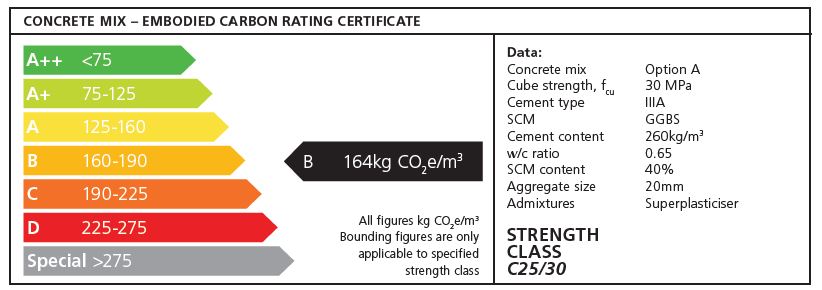
In the current version, the Infographic at the start of the document which illustrates the routemap, states that the use of fly ash and slag should be increased. I think a blanket statement along these lines is a mistake. The LCCG are also proposing benchmarking concrete with a scale similar to that we are used to seeing on white goods. Another mistake in my opinion. These two headline statements will encourage a race to low ratings and whatever it says in a paragraph on page 44 of the document, that will be driven in the only way currently practically possible, i.e. by increasing fly ash and slag contents. Yet in the LCCG’s own words, it may not reduce overall global greenhouse emissions.
Benchmarking proposal in Low Carbon Concrete Routemap
Slag and fly ash are vital ingredients for producing durable concrete yet it is a resource that will only diminish. These supplementary cementitious materials:
Improve the chloride resistance of concrete
Improve the sulfate resistance of concrete
Help resist delayed ettringite formation and alkali-silica reaction
Reduce temperatures in large pours helping to reduce the risk of thermal cracking
….and much more.
However, there are also negative aspects. Ask any contactor what they think about high levels of slag in their concrete and you may get a very flowery response littered with some ancient Anglo-Saxon terms, particularly at this time of year as the temperatures drop. The slow setting of the material is accentuated and construction programmes are delayed as formwork striking times are extended and concrete gangs work late into the night waiting for concrete to set so they can apply a finish. Measures to counter the cold weather are then taken. Space heaters may be introduced on site or concrete grades are increased to put more cement in the mix to speed-up strength gains. All measures which increase the carbon footprint of the project.
All these measures and problems would be worth it if the use of SCMs were making a difference in the fight on climate change, but as I keep saying, they’re not. At best they are making no difference to global CO2 emissions and at worse, will increase them.
We should not be throwing slag and fly ash into concrete to chase an arbitrary meaningless rating, instead we should be treating them as valuable resources and use them in situations where their thermal and durability properties are most needed.
I’m not advocating doing nothing, although that would be better than using high levels of slag or fly ash. There are materials in plentiful supply that could be used. There are lagoons full of conditioned fly ash which could be utilised, limestone fines are widely available and calcined clays could be. All have drawbacks and problems that will need investment and effort to overcome so we should be looking to ways to incentivise this approach. These materials are all discussed in the LCCG Routemap, but because slag and fly ash remain the easy option in the document, there will not be any focus on the more difficult and sustainable alternatives.
I’m going to make a radical suggestion, that will probably go down like the proverbial bucket of cold vomit. The idea needs more thought and work, but I think it could form the basis of the way forward.
Fly ash and slag have a lower carbon content than CEM I and their use should be maximised but preferably near their country of origin and in applications where their durability properties are required.
Let’s accept that the arbitrarily shipping fly ash and slag around the globe doesn’t reduce the global CO2e figure for concrete
Calculate the CO2e of concrete on a global basis (see equation below)
Use this figure for any type of cement that incorporates normally sourced fly ash or slag and for CEM I. This means there will be no sustainability advantage for using slag or fly ash.
When conditioned fly ash, limestone fines, calcined clay or other plentiful supply or under utilised material is used in cement production, use the product specific value, which will lower global CO2 contents and can therefore be positively recognised in the LCCG’s benchmarking system.
where
XXX eCO2 is the embodied carbon per tonne of the material based on a global assessment
XXX gb.usage is an estimate of the global usage of the material
I don’t want to get bogged down in to a discussion on how to derive these figures, it’s the general principal I’m trying to establish but I imagine it would give a figure somewhere in the low 800s kgCO2e/T.
I see this as having the benefit of stopping the use of large percentages of slag and fly ash for sustainability rather than durability reasons and will encourage innovation in low carbon concrete that might make a real difference to global CO2 levels. The LCCG’s benchmarking proposals will also work better with this type of approach.
I also believe we over specify concrete for strength and in some cases durability and that we should be looking to use less cement as well as lower carbon cements and pursuing lean designs but that will be the subject of a future posting (this one is already long enough!).
There is much to do if we are serious about tackling concrete’s impact on climate change and ditching the snake oil is a good place to start.
Do you make New Year’s Resolutions? I must confess to having mixed success with mine. I made one three years ago that has become much easier to maintain as time has gone on. In an effort to improve my fitness I pledged to walk up the stairs to my desk rather than take the lift. My desk is on the top (6th) floor of Mott MacDonald House in Croydon, 124 steps, so not an insignificant undertaking. Given that I also cycled to the station on my Brompton, I also had to lug my bike up all those steps, which was hard work.
I did pretty well and most days I kept to my resolution. It became easier when I decided to start walking to the station rather than cycling and I was generally only using the lift when I was collecting a visitor from reception. I have achieved 100% compliance with my resolution over the last nine months. Not because it has become an established habit but thanks to Covid, I have been working at home where there is no lift and just one flight of stairs to negotiate.
This year I am setting myself some more challenging targets around being more organised:
1) Keep my to do list up to date.
2) Complete my timesheet at the end of each day rather than each week.
3) Do my project management tasks on time
4) Regularly update this blog (at least once per month and preferably more often).
You will know in due course how successful I have been on the last one. The others will largely be known only to me but I must admit I don’t start off with a great deal of confidence in my ability to keep them up as I usually find project deliverables get in the way.
On to the third and final leg of my trip in bullish mood after some positive meetings with colleagues in Abu Dhabi and Dubai but still feeling the effects of my Bangladesh food poisoning. Over the last two years, when I’ve mentioned I’m visiting Bangladesh I don’t think a single person has offered to take my place or looked at me enviously and expressed a wish that they could come with me.
But that has all changed with my latest venture. I’ve had so many offers to carry my bags that if I’d accepted them all I wouldn’t have needed any suitcases, I could just give everybody a single item of clothing to carry. I mean, what is it about the Maldives that makes you all go weak -at-the-knees with envy?
Is it the fact it’s 32 degrees Celsius?
Or is it the soft white sands?
Or maybe the crystal-clear blue water?
Make no mistake, this is not a holiday, we are here to work. Judging by the plane I flew in on, I’m in a minority of one. The plane was full of couples: old couples, young newlyweds and couples of every shape size, colour and sexual orientation in between. All kissing, cuddling and whispering in anticipation and excitement of their romantic break. Oh, and me, the world’s biggest gooseberry, third wheel or whatever your preferred phrase is. I didn’t even have my colleague with me as we had gone our separate ways over t he weekend and planned to meet up in Male.
We are here for the first stage of a new project funded by the Asian Development Bank looking to divert construction and demolition waste and the residue from Municipal Waste Incinerators from landfill to more productive purposes. So, while the aforementioned couples dreamily headed off to those beautiful islands, the highlight of my day was visiting the capital’s waste transfer station.
Tomorrow we catch a ferry in the morning and head off to one of those neighbouring islands, Thilafushi, also known as the waste island. Maybe it’s the attraction of a large landfill site at 32°C that appeals to you or is it that nobody mentions Brexit?
I’ve arrived in Dubai on the next leg of what my son calls my mini Gap Year. The change of view from my Bangladesh Hotel to my Dubai Hotel is welcome.
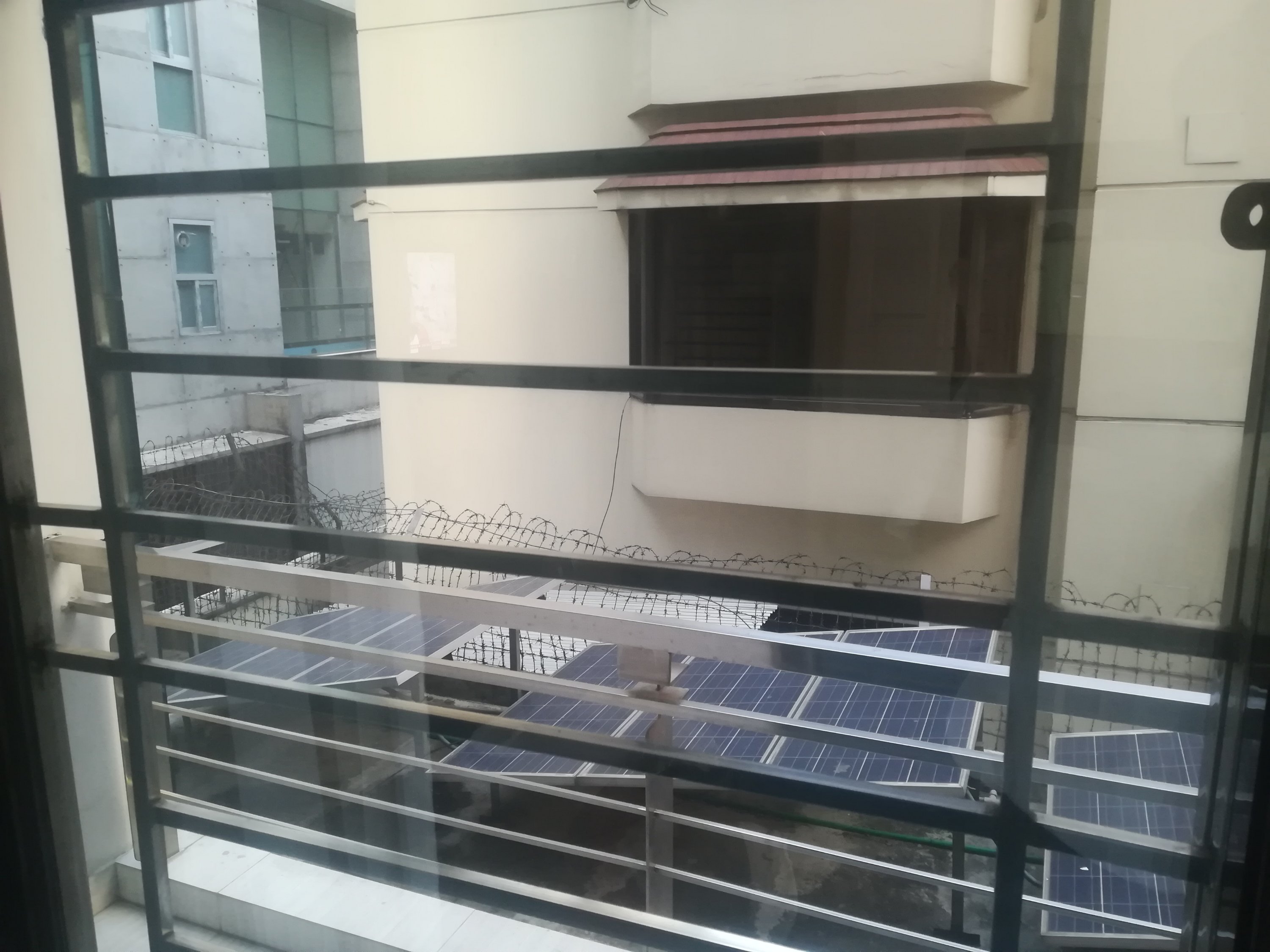
Room with no view (Dhaka)
Room with a view (Dubai)
Somebody once told me that during the cold war British spies operated under cover as cement salesman. The fact that cement goes everywhere in the world apparently offered the perfect cover for their clandestine activities. I don’t know if this is true, but I rather like the thought of a smooth talking cement salesman suggesting your concrete should be “shaken not stirred”. I tried googling to see if I could find any evidence and I did find some interesting facts that suggest it might not be a million miles from the truth.
For example the connection is made by Lord Selborne, who was Director of Cement in the Ministry of Works during WWII and left this role to become Minister of Economic Warfare, which put him in political control of the Special Operations Executive, the organisation responsible for organising clandestine activities in occupied Europe. Atlantic Wall, a musical based on a true storey about the French Resistance has a character, Henri Giraud, an ex- First World War artillery officer, recruited to develop a fledgling spy network in Normandy. He uses his job as a cement salesman – which allows him to travel freely between Paris and his home town Caen – as cover for his intelligence work.
Why this interest in espionage and cement? Well it’s partly to add a bit of glamour and excitement to the “grey” world I work in and partly to put into context the second part of this post. I’m taking the opportunity of being in the UAE, to promote the activities of the small part of Mott MacDonald I belong to. While our, Bridges, Tunnels, Ports, Coastal and Offshore operations have no problem selling their skills – “they do what it says on the tin” as the advert goes, our function is not so clear.
I work for Special Services! Our team has nothing to do with clandestine operations (although I would say that wouldn’t I) but we are the repository that ends up with projects that nobody else wants to and/or can deal with. We were formed when alkali-silica reaction was dominating the concrete world back in the mid-1980s and there was a belief that they needed to bring together structural and materials expertise to address the problem. We’ve developed a wide-range of skills over the ensuing years as problems have come our way.
Some of our areas of expertise are shown below. Do not hesitate to contact me if you’d like to find out more about any of these special services we provide.
I apologise if you can’t get the image of me wielding a Schmidt Hammer with a licence to kill out of your mind. In that case I’m just glad I didn’t mention the other kind of special services that are offered by certain kinds of ladies in the personal ads of your local newspaper. Oh dear, too late!
List of some of our Special Services
Dynamic Analysis,
Forensic engineering,
Slab track analysis and design,
Human induced vibration,
Durability modelling and design,
Cathodic protection,
Wind engineering,
Blast analysis and design,
Noise and vibration measurement, analysis and mitigation,
The wonders of modern technology are allowing me to post this message from somewhere near Mosul, well 36994ft above it actually. I’m heading to Bangladesh for the final stage of a DfID funded project we’ve been working on for a couple of years in which we’re trying to improve the durability of their concrete in the coastal regions.
It’s been quite an interesting challenge as the country has very little in the way of natural resources (most coarse aggregate and cement is imported) except clay so they make a lot of bricks and crush them up to use as aggregate.
There is a strong belief that stronger is better and that supplementary cementitious materials are bad – a view we’ve tried to change by introducing durability testing like the Nordtest NTBuild492. My colleague Sudarshan Srinivasan presented the a paper at the durability conference in Leeds last year which summarised the work (and won 2nd best paper award). If you’re interested I can let you have a copy.
Now all we have to figure out is how to get the technology to be able to stop the chap sitting next to me from waking me up so he could go to the toilet after I’d eventually fallen to sleep!




 It's grey and goes hard