Classy cements

We just love to classify things.

  • Our social status (upper class, middle class , working class)
  • Our cars (MPV, saloon, mini, hybrid, estate etc)
  • Our bread (granary, wholemeal, sourdough etc)

I quite liked this classification of science.

The classification of cement in various standards has caused some confusion amongst colleagues so I thought I’d share my conclusions with you.  Eurocode 2 uses a simple classification system when calculating early age strengths, creep coefficients or drying shrinkage strain.  Depending on the rate of strength gain, concrete is classified as either Class R, N or S. 

The European cement standard, EN 197-1 uses a similar classification system.  Until the November 2011 amendment of EN197-1, the standard only had two classes of early strength for each standard strength class – cement with ordinary strength gain indicated by N and high early strength by R.  The 2011 revision introduced a third category “L” (I suppose “S” would have been too obvious!). 

The introduction of Class L at least brought EN 197-1 in line with the complementary British Standard to EN 206, BS 8500, which also uses the designations Class R, N and L.

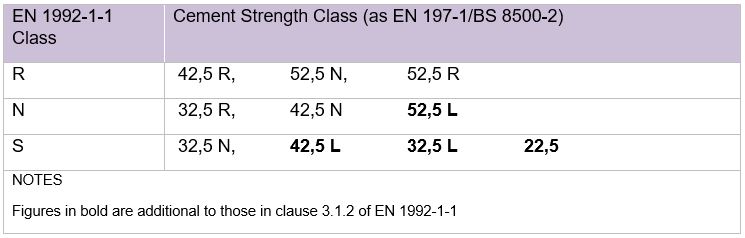
I hope you’re following this as it’s about to get more confusing.  The table below reproduces the cement classes given in clause 3.1.2(6) from EN 1992-1-1.  The list of cements does not cover the full range of cements in EN197-1 or the range typically used in the UK.  Furthermore, it is immediately clear from Table 1 that the classes used in EN 1992-1-1 do not correlate with the designations used in EN 197-1 (e.g. CEM 52,5N is class R while CEM 32,5R is class N).

I need to add another standard in here, BS EN 14216 which covers the specification and performance of very low heat cements.  There is actually close correlation between the definitions of R, N and L in  EN 197-1, EN 14216 and BS 8500 but  irritatingly there are some differences as shown in the table below (figures in brackets show the discrepancies between the standards).

From the Table above, it can be seen that a 32,5R has the same minimum 2 day strength as a 42,5N which helps to understand the logic of the classes used in EN 1992-1-1.

The question I often get asked is what class should be used for cements not covered in clause 3.1.2 of EN 1992-1-1.  In the table below, I have extended the range of cements with my additions shown in bold.
Often full descriptions of the cement are not available and we may only know the generic type.  I use the assumptions in the following table in those circumstances.
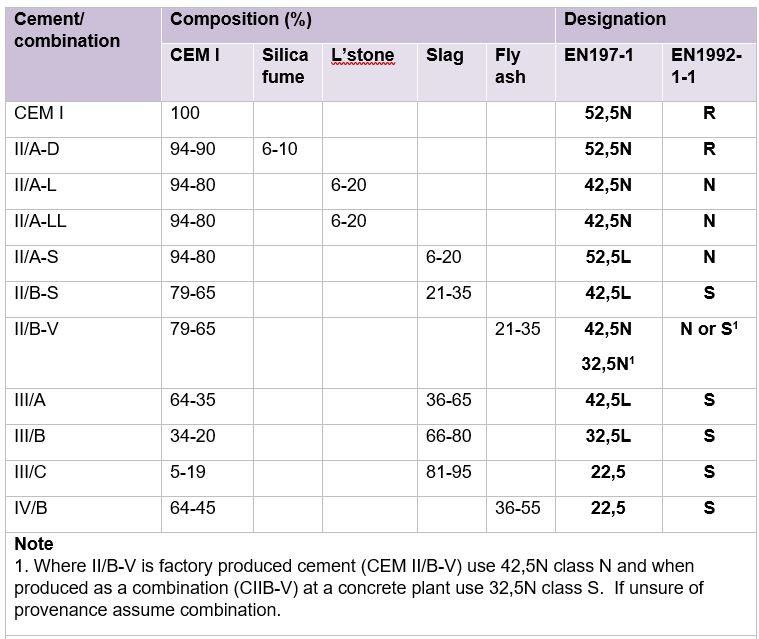
These are my own personal view and you are welcome to use them, but their use comes with no guarantees. Any comments?

To infinity and beyond

Chloride ions are highly mobile, which can cause problems for reinforced concrete. The chloride ions can penetrate into concrete over time and when their concentration around the steel reaches a critical mass, the passive protection layer formed by the concrete can be broken down leading to rusting of the steel and spalling of the concrete.

BS 8500 defines chloride exposure conditions as either XD for deicing salts applied to roads or XS in a marine environment. Both these classes are divided into 3 cases, with the most onerous being XD3 and XS3 (where the concrete is cyclically wet and dry).

The XD3 and XS3 areas are clearly defined e.g. XD3 is for structures within 10m horizontally of a carriageway or for bridge soffits within 5m vertically. However, it appears that Buzz Lightyear was on the drafting panel when XD1 zone was defined. XD1 is for structures greater than 10m horizontally and 5m vertically from a carriageway; i.e. to infinity and beyond, as no limit is specified.

Generally, this doesn’t have too big an impact on specifications as the limiting values (strength, water cement ratio, minimum cement content and cover to reinforcement) are not too onerous for XD1. However, sometimes specifications don’t permit certain materials to be used in a chloride environment, e.g. weathering steel, so if we are building a bridge near a motorway we need to have an idea what the likely spray zone is to know if these material restrictions apply.

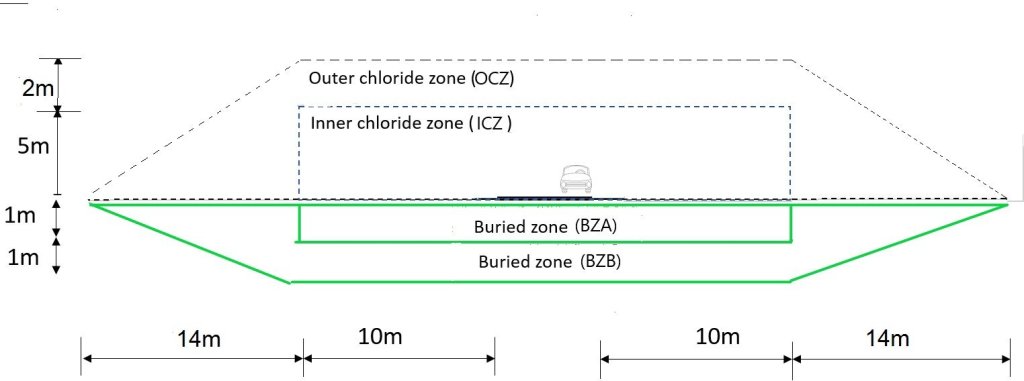
For a recent project I’ve been working on, I came up with the following envelope using probabilistic modelling on the relationship empirically derived in Germany and used in fib bulletin 34 for the maximum content of chloride in a profile against distance from carriageway:

There is less research around to help evaluate the penetration of chlorides into the soil. However, considering the following facts:

  • Salt is usually applied in freezing conditions therefore the chloride contaminated water will tend to run-off the hard ground.
  • Chloride ions are mobile and will tend to flow away with groundwater
  • Research shows increased chloride in aquifers near roads with salt spreading because the chlorides have been transported away (supporting the first two points above)
  • High concentrations of chloride are not normally found at depths >1m

On this basis I limited the buried chloride zone to 2m giving the following overall envelope.

Logic tells you that a concrete element close to a motorway which will have a lot of traffic and relatively frequent salt addition in cold weather will be at far greater risk than one alongside a quiet road that may only get an occasional gritting and far less spray

It seems reasonable to me that you could differentiate your specification between busy (e.g. ‘M’ or ‘A’ roads) and quiet (e.g. ‘B’ or ‘unclassified’ roads). So my suggestion would be:

  • Any element subject to direct application of chloride (quiet or busy road) design as XD3
  • Any element in the ICZ on a busy road design as XD3 and XD1 in the OCZ.
  • Any element in BZA on a busy road design as XD3 and XD2 in BZB
  • On quiet roads use XD1 for all zones (except where subject to direct application- see above). Note to comply with the current versions of BS 8500 concrete in the ICZ should be classified as XD3 exposure (on both quiet and busy roads).

What do you think?

Happy birthday BS 8500

Last week BS8500, the complementary British Standard to EN 206 (the European Standard on Concrete) came of age. Although I live reasonably near the BSI HQ in Chiswick, I was not disturbed by any wild parties, in fact I’m pretty sure the 18th birthday passed by unnoticed by all. In the UK, becoming 18 marks the point when you are legally entitled to, amongst other things:

  • Serve on a jury
  • Get a tattoo
  • Buy an alcoholic drink in a pub

BS 8500 cannot partake of these new rights, but I bet that grappling with BS 8500 has driven more than a few engineers to drink over the years. You would have thought that after 18 years we would know how to use the Standard, but I keep coming across examples of it being incorrectly applied. Back in 2011 when BS 8500 was still young, I was motivated to write an article for the Structural Engineer magazine highlighting a common error that engineers made when using the Standard, and it’s still being made.

So, as my birthday present to this fundamental Standard of our industry, I’m going to go over the issue again and see if we can prevent a few more of you from making this error.


Technical jargon warning

The article gets a bit techy from here


Those of you familiar with the Standard will know that Tables A.4 and A.5 are the key tables in which for a given exposure environment, you determine your cover to reinforcement, concrete limiting values (i.e. strength, minimum cement content and maximum water cement ratio) and cementitious material type to achieve your required design life. Table A.4 gives the requirements for a 50 year design life and Table A.5 for a 100 years.

The two Tables give the specifier options. To achieve the design life, they can either specify a:

  • higher cover with a lower quality concrete
  • higher quality concrete with a lower cover

The quality of concrete can be improved by using a better performing cement and/or a lower water cement ratio (and associated higher minimum cement content and strength).

So, for each different exposure condition the specifier has a range of options to choose from. For example, consider a concrete element exposed to a marine splash zone (exposure class XS3) and a 50 year design life. Table A.4 gives the specifier 23 options with strengths varying from C20/25 to C40/50 (and all grades in between), 4 different groups of cements and minimum cover to reinforcement from 45mm to 80mm inclusive. In terms of the Standard, all these options are equally valid.

The common mistake I keep coming across is that the specifier who may have an element that requires a design characteristic strength of say C32/40, believes that they must look up that strength in the XS3 exposure class row in Table A.4 and then use one of the two combinations they find i.e.


C32/40 mcc 360 w/c 0.45 with IIB-V or IIIA cement and 60mm cover


C32/40 mcc 360 w/c 0.45 with IIB-V (min 25% fly ash) or IIIA (min 46% slag) cement and 60mm cover

Worse still, the specifier will often compound this error by restricting the cement type, e.g. there is no C32/40 option in Table A.4 for cements with a high supplementary cementitious materials content, so the specifier will exclude IIIB or IVB-V cement.

While this is a solution that meets the requirements of the Standard, it is unnecessarily restrictive and could be technically poor, e.g. if it is a large element that requires a low-heat cement to minimise the risk of thermal cracking.

Instead it should be noted that the limiting values in Tables A.4 and A.5 are a minimum. If the specifier wants to use IIIB cement at 50mm cover then Table A.4 says you need a minimum specification of C28/35 mcc 360 w/c 0.45 to meet durability requirements. If you need C32/40 for structural reasons then specify C32/40 IIIB cement mcc 360 w/c 0.45 with 50mm cover and your concrete will comply with both structural and durability requirements. Four of the 23 options have durability limiting values with a strength greater than C32/40. The specifier can still use these options but they will have to increase the limiting values, including strength, to match the requirements in Table A.4.

Simple?

#concrete #BS8500 #EN206