
Those of you of a certain age, may remember the musical spat in the 80s between Michael Jackson and Lydia Murdock. Jackson released ‘BillieJean’ in January 1983 apparently based on groupies’ claims against his brothers that they were the father’s of various babies from assignations that took place when they used to tour as the Jackson 5. Lydia countered with ‘Superstar’ which alledgedly attacked Jackson for his denial of paternity. Roll forward nearly 40 years (is it really!!!) and a recent disagreement brought this Jackson saga back into my mind.
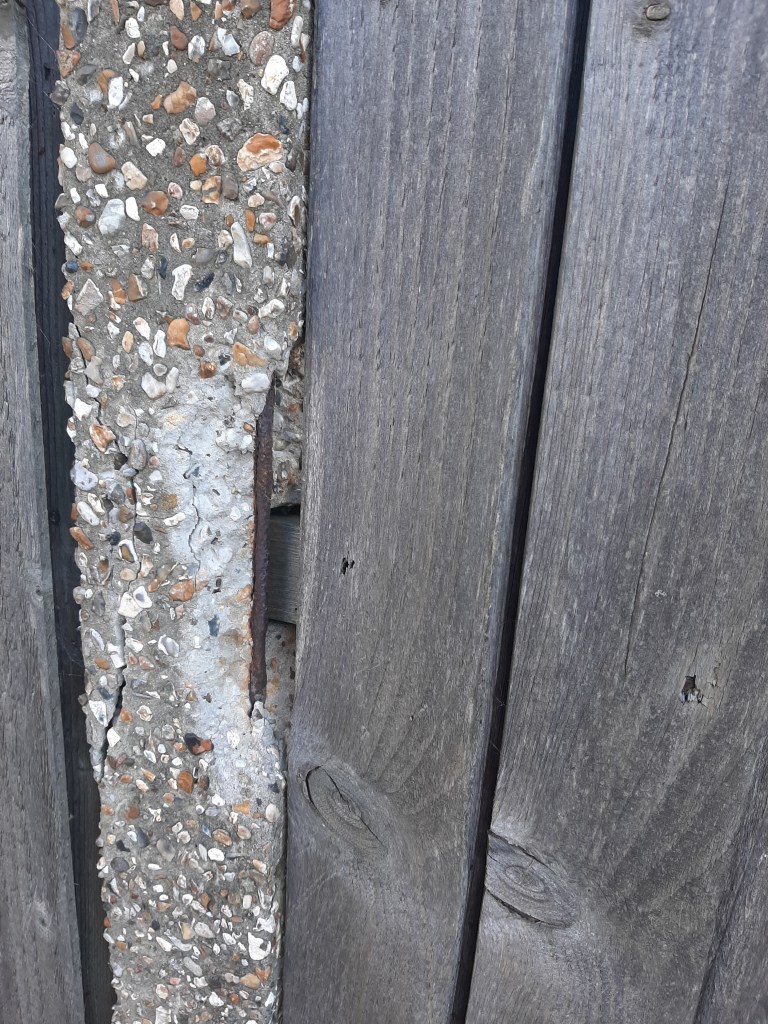
Dezeen ran an article on 24th August stating that “Concrete construction “offsets around one half” of carbonate emissions from cement industry says IPCC“. As a durability specialist I spend my days designing and specifying concrete to resist carbonation as the process can lead to the corrosion of reinforcement and spalling of concrete (as my fence posts play testament to) so I’m always a bit concerned when this argument is used in favour of concrete.
The following week Dezeen ran another article “Cement and concrete “are not carbon sinks” says Cambridge materials scientist”. The Academic taking on the Lydia Murdock role said that he was frustrated by. the IPCC Report because concrete only absorbs a fraction of the total CO2 produced by cement. The IPCC put it at 50% (i.e. 1/2 – definitely a fraction). while the Cambridge academic said it was only 25% i.e. 1/4 (definitely another fraction). He argued concrete was not a carbon sink because it did not reabsorb all its carbon and instead we should be using more timber or plant based material. Cement after all is responsible for 8% of all CO2 emissions.
As I said, I have some disquiet about the argument of carbonation being good, but I vehemently disagree with the concrete being bad and wood is good mantra. Wood at best, to my mind, is a temporary store of carbon, because at the end of its life it will be burnt or rot and release all that captured carbon back into the atmosphere. Not to mention all the land that would need to be put over to tree production to even remotely get close to the sort of levels of production needed to replace the ubiquitous concrete and also forgetting the inability of timber to replace many of concrete’s applications (wooden roads anybody? Or tunnels? Or runways? Or crash barriers?). Concrete’s problem is that it is so successful. It is strong, durable, fire resistant, cheap, locally available; in short, sustainable. It’s huge emissions are due to it’s extensive use. We all by now must have heard the fact that concrete is the second most widely used material after water. So what is water’s carbon footprint? After all it needs to be captured cleaned, stored, pumped, treated etc. The River Network published a report in 2009 that said:
Through our analysis of primary and secondary research, we estimate that U.S. water-related energy use is at least 521 million MWh a year—equivalent to 13% of the nation’s electricity consumption. While this appears to be a conservative estimate of water-related energy use, our findings suggest that the carbon footprint currently associated with moving, treating and heating water in the U.S. is at least 290 million metric tons a year. The CO2 embedded in the nation’s water represents 5% of all U.S. carbon emissions and is equivalent to the emissions of over 62 coal fired power plants.
River Network
Does anybody seriously suggest we stop using water because of its huge carbon footprint? Ofcourse not. Sure, we can use less, we can find more efficient ways to treat it, heat it, transport it but we will always use it and there will probably be a large carbon cost involved. Concrete is in a similar position to water but to my mind has a more realistic chance of being carbon neutral or even becoming a carbon sink. Carbon capture technologies are being developed and if we can get them to work effectively, capture the carbon used in production, then whether the carbonation process captures 25 or 50%, concrete will become a genuine carbon sink and will be able to capture all that carbon being released by rotting and burning timber that had been naively used as the answer to climate change.
 It's grey and goes hard